Fundamentals of Xuan Kong – Classical Feng Shui – part I: the Beginnings
Have you ever walked into someone's house and felt instantly at home?
A feeling of peace and warm hospitality. A welcoming atmosphere. A perfect balance between comfort and style… Everything just felt right. And the people living there also looked vibrant, relaxed and happy!
As an architect, I’ve always wanted to create that — on purpose — places where people feel good.
So, I learned Feng Shui, the Bagua — Eight Life Aspirations — and applied what I was told: fire in the south for fame, water in the north for career, plants in the southeast for prosperity… and done! There I was, waiting for results. Sure, my house felt better (I was also cleaning, decluttering, and consciously putting intention in beautifying it) but nothing remarkable changed in my life.
“Really? Millennia of Chinese Mastery to simply that?”
Feng Shui disappointed me.
And for many years I remained skeptical.
“There must be something else…”
And one day, by chance, I heard about Classical Feng Shui — the ancient Asian method that has been kept inscrutable for the westerns because of its depth and complexity.
Bingo! I knew this was something different. And, as I found later, it has little to do with hanging crystal balls, placing bagua mirrors to repel “negative energy”, or decorating with certain colours. (Fun fact: in ancient times, houses were mostly painted white; ready-mixed coloured wall paint is a relatively modern invention.)
But then, how old is Feng Shui?
A lot older than you think.
From Neolithic Graves to Condo Buildings
Our problems are not new.
Modern challenges and aspirations are essentially similar to those faced by our Neolithic ancestors:
How can we change our current situation and future fate from misfortune to good fortune? How can we live better, have peace, and avoid disaster?
The origins of Feng Shui are more complex than just the ancient Chinese observing nature. Certainly, prehistoric farmers were skilled at understanding seasonal changes and astrological patterns. They recognized correlations between cosmic cycles and life on Earth: abundant harvests and healthy livestock were a guarantee of prosperity. With observation, experience, and intuition, they learned that living in harmony with nature made life easier, while upsetting the balance of their environment brought on disasters.
Yet not only the naturalists contributed to the appearance and development of Feng Shui. There was another powerful influence; a strong ancestral belief passed down from generation to generation:
Good fortune extends from the dead to the living.
The Chinese believed their forebears could bestow wisdom and good luck upon their descendants. Between earth, parents, and offspring, there is actually one connected qi (like the soil, roots, and branches of a tree) And this life-giving energy — sheng qi — moves within the ground.
From that belief came the practice of burial, the need to pick auspicious gravesites, and some sort of primitive feng shui, around 6500 years ago.
“When the land is excellent, the spirits will be comfortable and the descendants will flourish.”
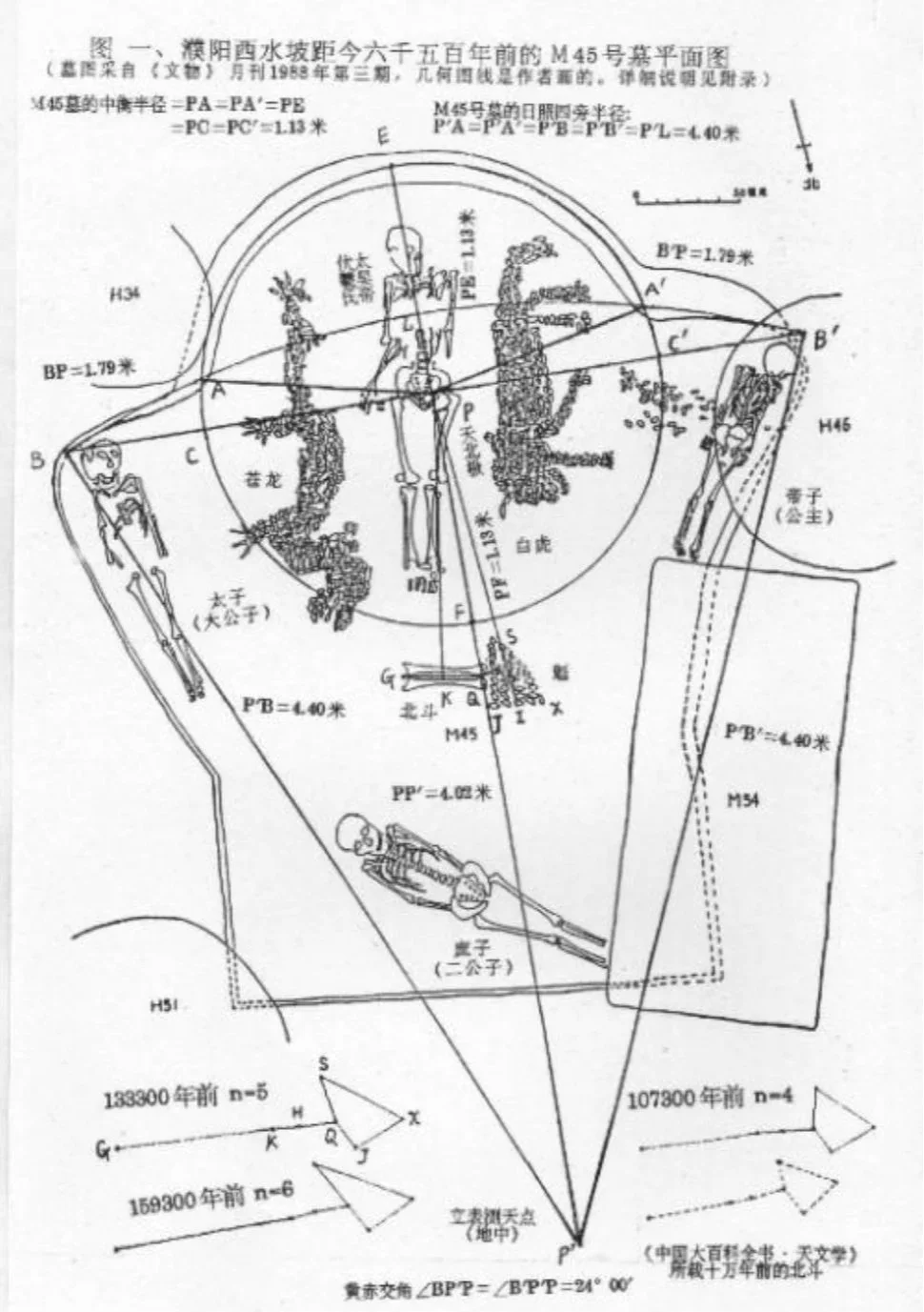
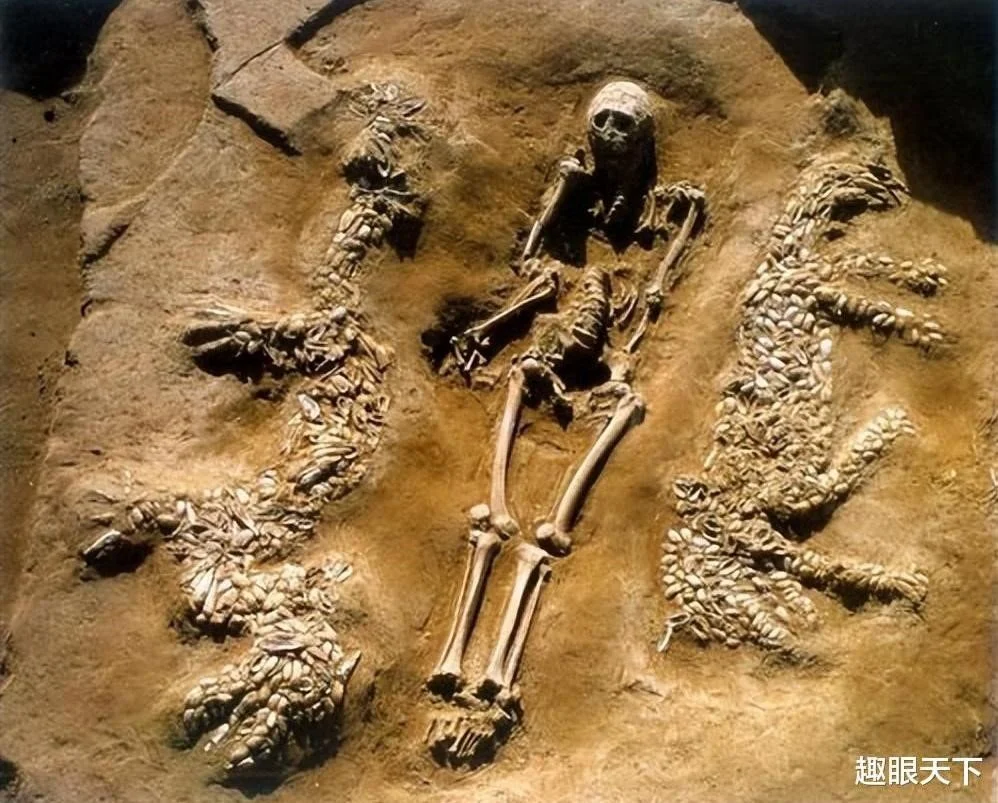
Yangshao tomb at Xishuipo, Neolithic site in central China.
Inside the chamber, the head is oriented to the SOUTH (circular/domed shape represents Heaven), and the feet point to the NORTH (rectangular/flat shape represents Earth).
Man is positioned between Heaven and Earth, flanked by two guardian animals depicted in clamshell mosaics: a dragon to the EAST (representing yang ascending energy) and a tiger to the WEST (representing yin descending energy).
“If the ancestors’ bones gain sheng qi, the descendants’ bodies are endowed.”
The finding of this prehistoric site (c. 4500 BCE) testifies the fact that the Chinese were already carefully selecting the location for their relatives’ eternal rest and orienting their ancestors’ bodies according to the cardinal directions, even thousands of years before the first writing system appeared. Until the invention of the magnetic compass, early practitioners of Feng Shui relied on astronomical calculations to record the correlations between humans (both living and dead) and the universe.
Watercourses, Landforms, and the Best Location for Your Bed
At some point, the study of the land and the sky to find the most auspicious site expanded its scope from the dwellings for the dead to the residences for the living. Evolving from divining to avoid disasters to divining to actively seek good fortune, the goal remained the same: to guarantee welfare by choosing the right spot.
The most auspicious site was given a name: Long Xue, the Dragon’s Lair.
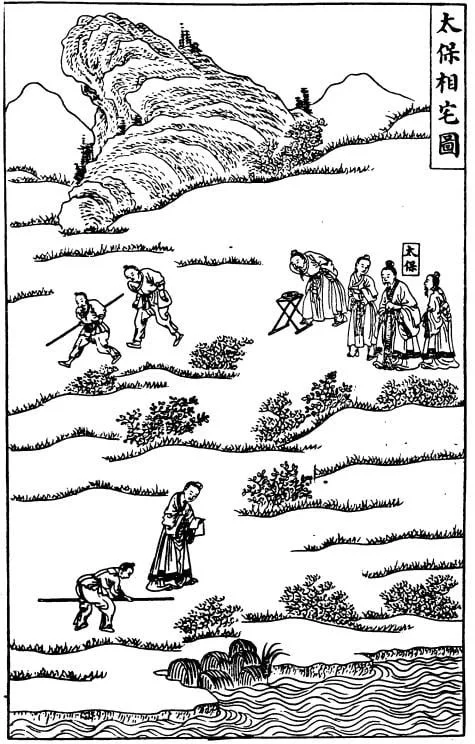
Fengshui Xiansheng 风水先生
“Choosing the Day and the Ground”
Selection of a building site by a wind and water interpreter or fengshui xiansheng (practitioner) and his assistants, using measuring rods and manuals.
The geomancer is consulting a compass or luopan set upon a folding table to discern directional orientation as well as other relationships influencing site selection.
The mountain to the back and the stream to the front are canonical elements of a good site, sheltered from the wind (“cangfeng”) with water at hand (“deshui”).
Source: “Chinese Landscapes: The Village as Place”, by Ronald G. Knapp.
The divination, observation, and analysis of the ground — known as Xiang Di some millennia BCE — evolved into Kan Yu, the ways (influences) of Heaven (time) and Earth (living environments).
The term feng shui was first written and defined in The Book of Burial (Zang Shu) — authorship given to Guo Pu (around 300 CE). More than a science, art, or practice, it refers to a whole Chinese cosmological concept. The Classic says:
“Qi is carried by the wind and settles in water.
Thus, it was called feng shui (wind water)”
Wind and water are two natural elements that flow, move, and circulate everywhere on earth. They are also essential to human survival. Wind — air, oxygen — is the breath of life. And water is the basis of life. All living organisms are largely composed of these two elements.
The combined qualities of wind and water determine the climate, which determines our food supply and, in turn, affects our lifestyle, health, energy, and mood. These two fundamental and flowing elements have always had a profound, yet subtle, influence on individuals and societies.
Vital qi will dissipate in the blowing wind.From stagnant waters come decline; they will not bring prosperity.
Wind and water are direct carriers of qi — the life force. The ancients were able to collect life-generating qi, prevent its dissipation, and guide it to cities, palaces, and houses, for the safety and blessing of the living.
That is Feng Shui — the skill of manipulating wind and water, and the art of seeking a balance between them.
The method of Form — Xingfa, the first and oldest school of Feng Shui, established during the Han Dynasty (206 BCE – 220 CE) — analyzes natural formations to determine their auspiciousness, the places where generative qi accumulates. In particular, the movement of water (winding, bending, still, straight, calm, turbulent) and the quality of the mountains (sharp, round, fertile, or arid) are the cues read by those who are wise at divining sites.
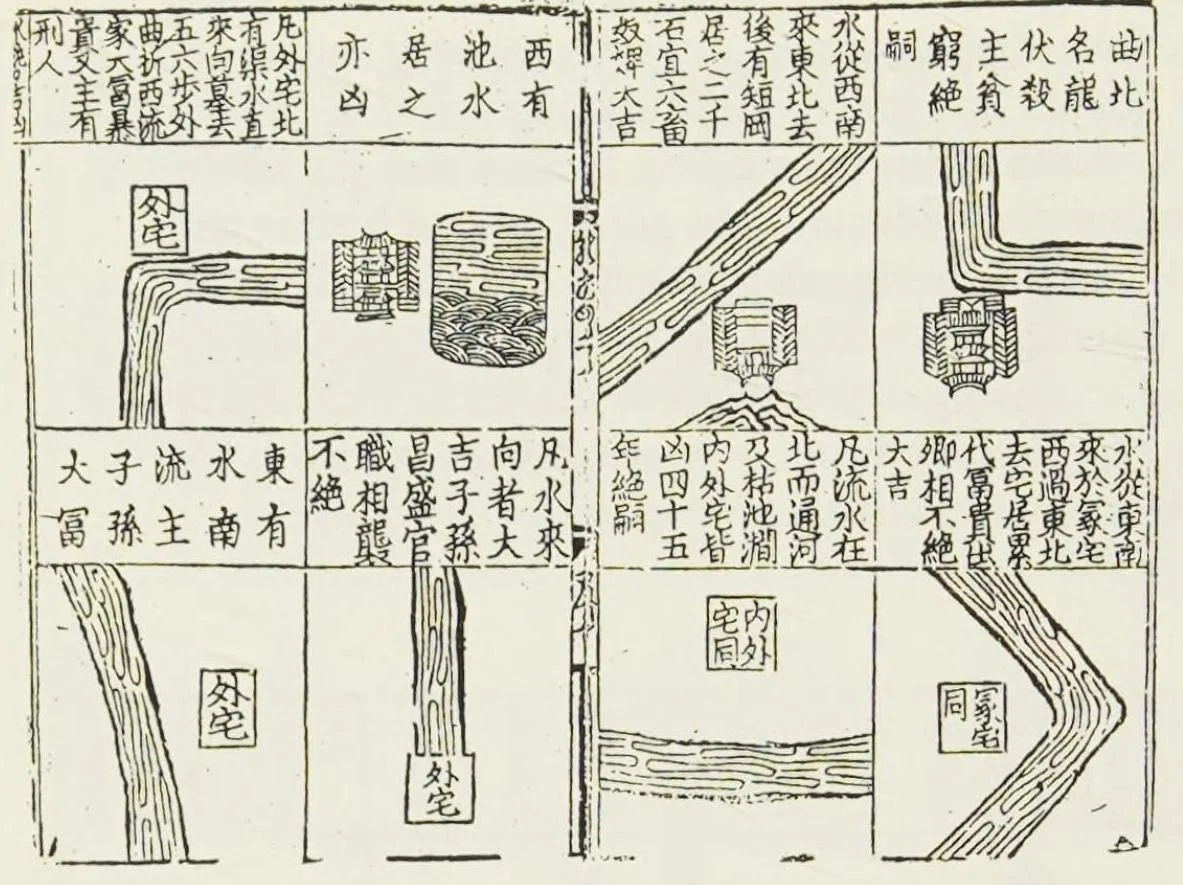
Examples of rivers, graves, hills, and houses — fortunate or unfortunate locations depending on the landforms and flow of currents. Source: Xu Xiu Si Ku Quan Shu (Shanghai Guji Chubanshe), vol. 1054, pp. 28–40.
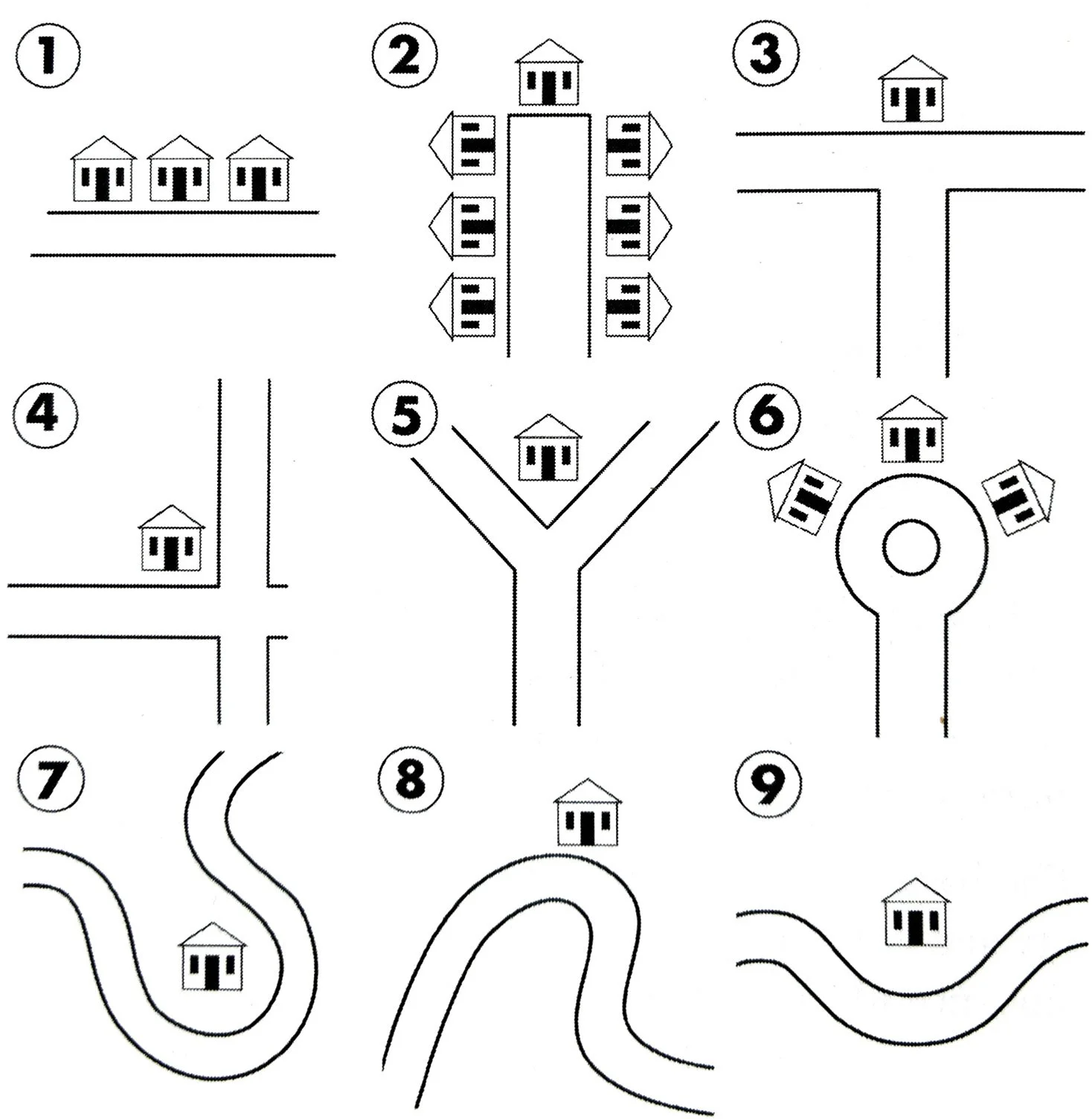
In the evaluation of the built environment, roadways are analogous to river courses. A meandering river is similar to a winding road; a busy road is similar to a fast current. Depending on their patterns and positions relative to the building, the current of qi can be auspicious (bringing sheng qi) or inauspicious (bringing sha qi). Source: “The Complete Idiot's Guide to Feng Shui", by Elizabeth Moran and Joseph Yu.
Now, how do these ancient methods and philosophical principles apply to our modern homes?
The key location that brings fortune and good health, highly sought after by the early masters to place the head of the deceased and the seat in the main hall, is as usable today as it was then. Why? Because the motive (reason to move, goal to achieve) is the same: a healthy, prosperous, and peaceful life.
“The Classic says: where mountains emerge and water encircle, there is nobility, longevity and wealth. If burial occurs here, good fortune is eternal.”
Going to sleep means becoming unconscious for a little while, leaving the day and the waking life behind, to enter a darker, deeper realm… somewhat like being temporarily “dead”. The place where our body rests at night can be read, in some way, as the ancients read gravesites.
Guidelines for applying the Form school principles to evaluate interior spaces:
Pathways, corridors, wind-ways, and the currents between doors and windows act like watercourses.
Heavy furniture, headboards, and solid walls act like mountains.
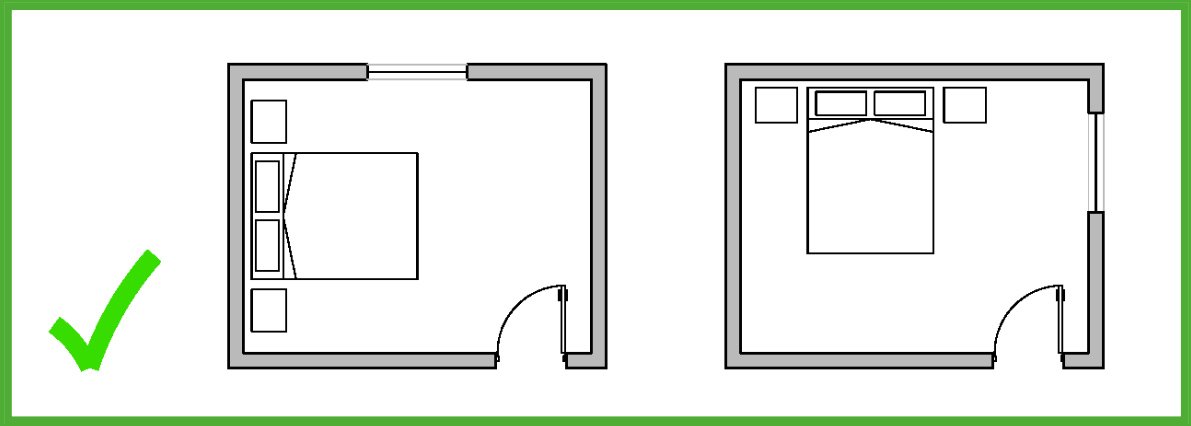
Favourable and unfavourable bed placements. Source: “The Complete Idiot's Guide to Feng Shui”.
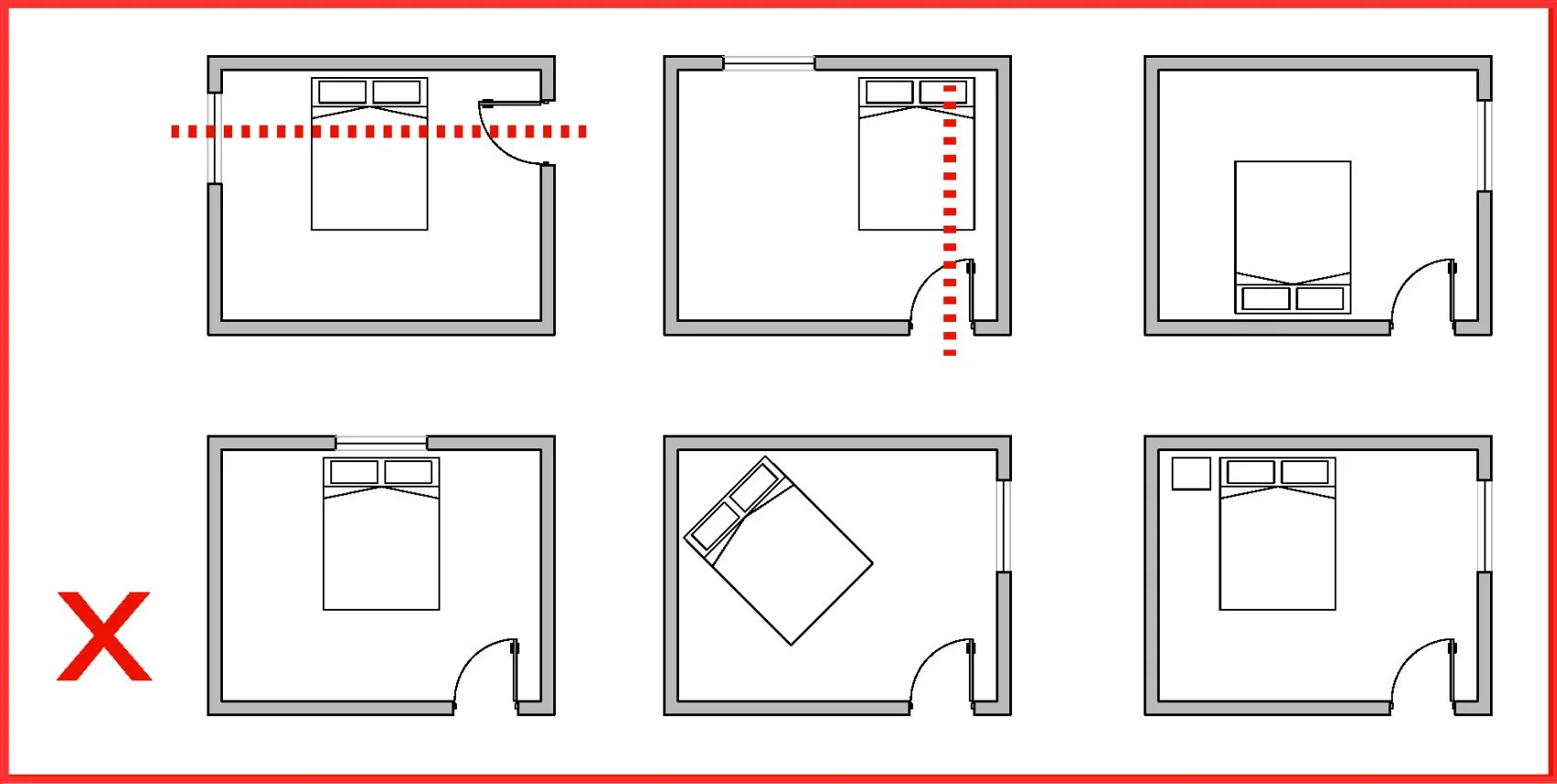
Can you guess now if your bedroom follows the basic principles for good Feng Shui?
Myths & Maths — The Magic Square
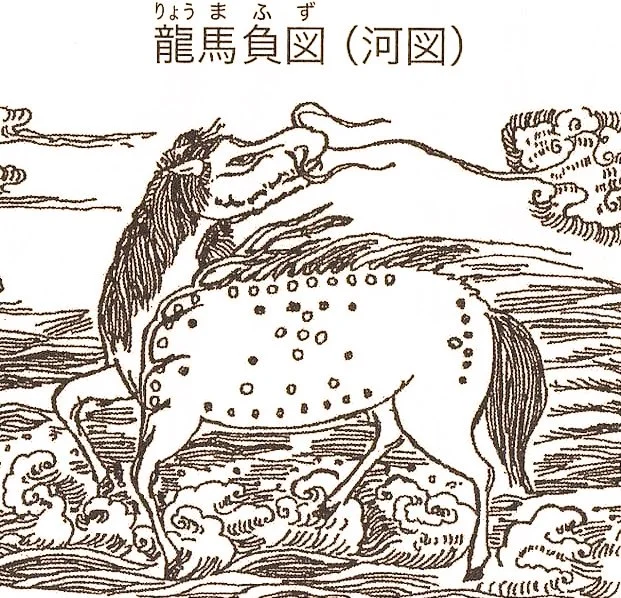
According to the legend, the first master Fu Xi — an emperor, shaman, or an entire tribe, still uncertain — at the time of the animal tamers (c. 3300 BCE), saw a dragon-horse emerging from the Yellow River. On the animal's flank was a pattern of black and white dots.
This pattern was called the He Tu — the River Chart.
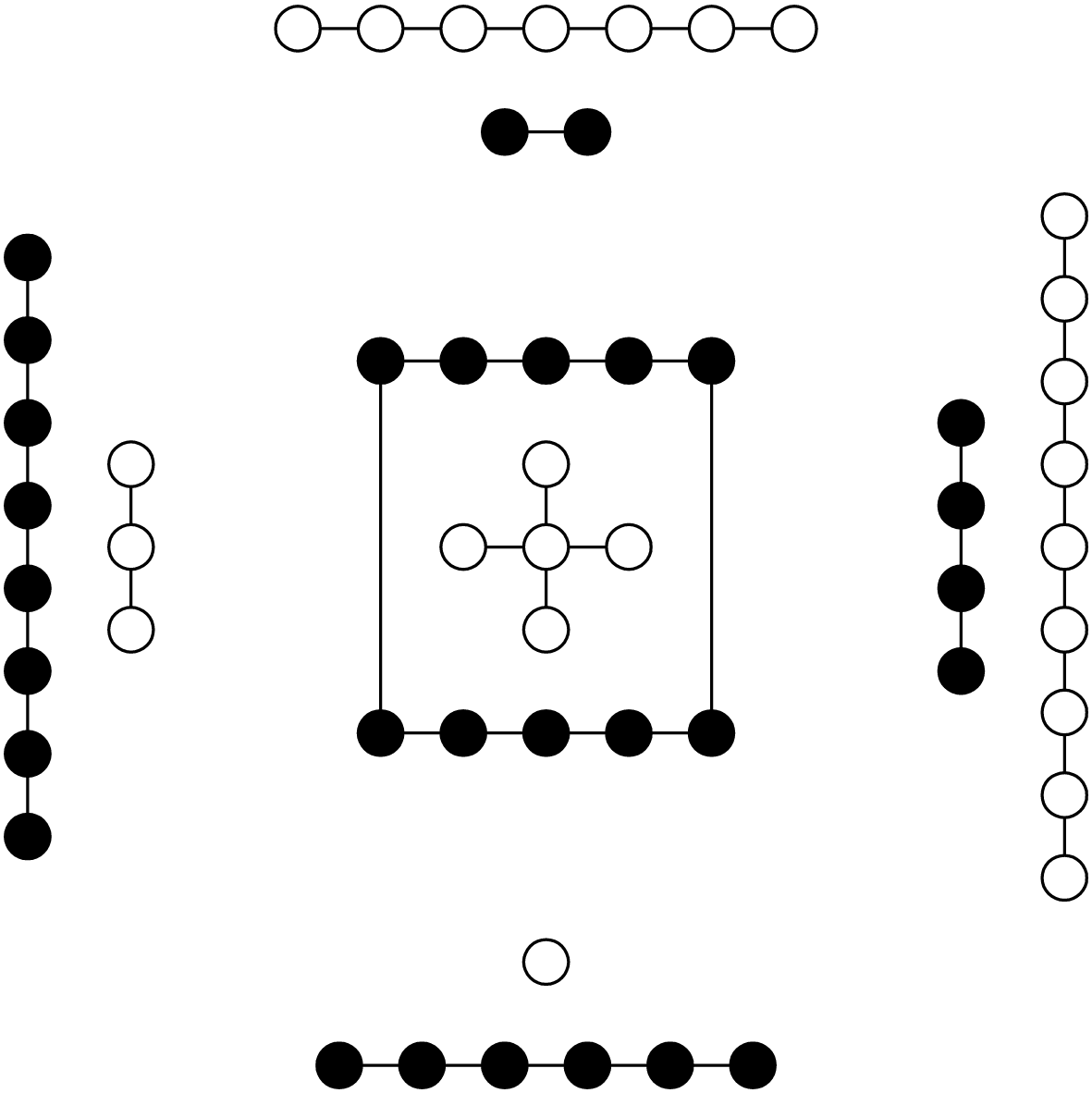
Decoding the diagram reveals valuable information about cosmic laws and the fundamental principles of Feng Shui: Yin-Yang, the Five Elements, the cardinal directions, and the flow of Qi.
The white dots were assigned a Yang polarity (Yang being bright as day) and the black dots were assigned a Yin polarity (Yin being dark as night).
Odd-numbered groups were white; even-numbered groups were black.
“Odd is Yang and even is Yin.
From odd and even are born the Five [patterns/phases].
The Eight Bodies are distributed.”
Fu Xi found straight lines easier to see, so he replaced the dots with lines: a broken line representing Yin and a solid line representing Yang. He then proceeded to stack the lines… and thus, the trigrams were born! The River Map gave birth to the first Ba Gua — the Xian Tian (Early Heaven) Ba Gua (Eight Trigrams). This sequence represents an ideal, static, motionless, perfectly ordered world at the beginning of time and space. Somewhat like a metaphysical Big Bang concept.
The Xian Tian is about birth and harmony.
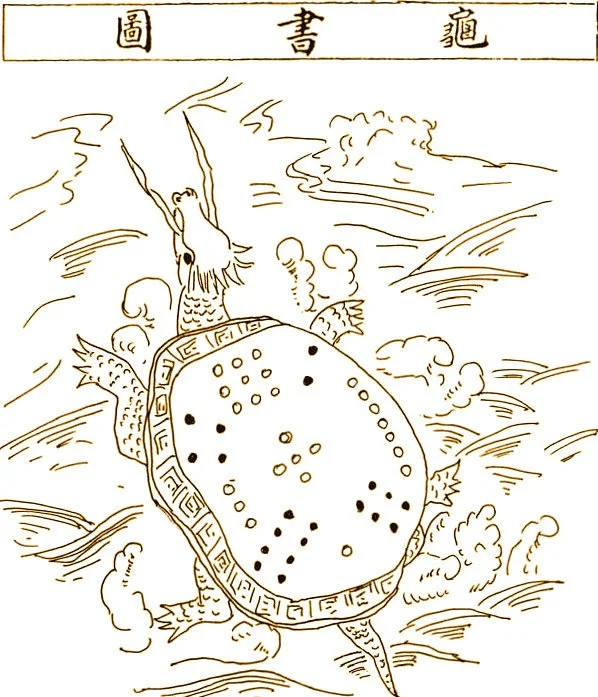
A second story was recorded in ancient texts: Emperor Yu, founder of the Xia Dynasty (c. 2100 BCE), was sitting by the Luo River when he saw a giant turtle showing a pattern of dots on its back.
This diagram was called the Luo Shu — the Map from Luo River — and correlates to the Hou Tian (Later Heaven) Ba Gua. This sequence of trigrams denotes motion, transformation, and the dynamic interaction between natural forces and human Qi.
The Hou Tian is about direction and growth.
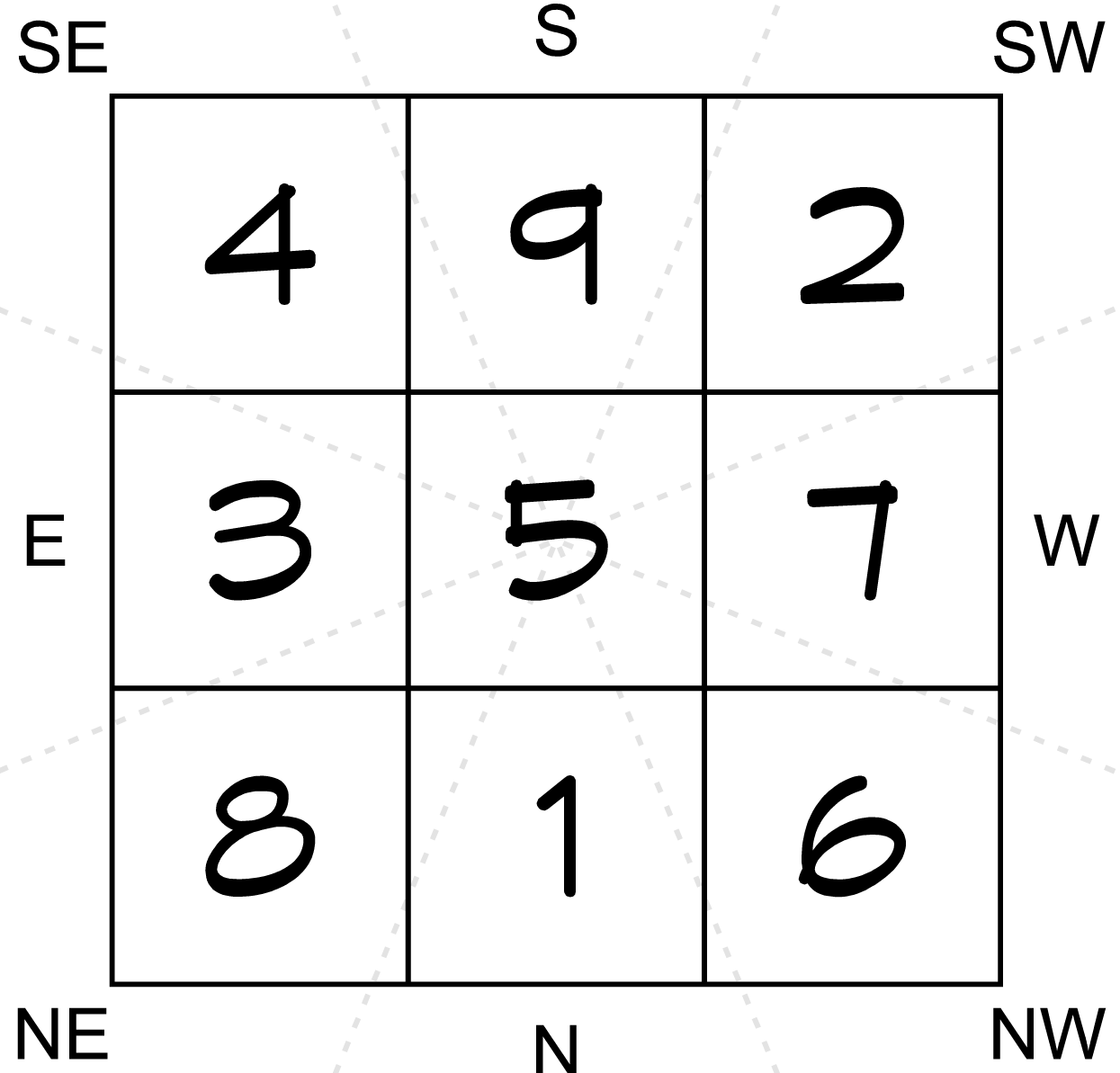
The black and white dots of the Luo Shu were displayed in a 3 x3 grid of numbers known as the Magic Square. Along any line, numbers add up to 15. Furthermore, when a certain sequence is followed connecting odd-Yang with even-Yin numbers/dots, a counterclockwise vortex figure appears — one of the oldest symbols of humankind and a fractal figure in some natural structures.
The nine numbers will now be called the Nine Stars — Numbers as representation of types of energies.
To understand how the trigrams (Yin-Yang combinations) relate to reality (energy + matter) we have to see them as encoded information that can be translated into mathematical terms, much like binary coding in computer science. Both approaches seek to describe the world we live in, finding order and cyclical patterns within what appears to be a chaotic, randomly behaving cosmos.
All matter can be represented in binary sequencing as ones and zeros (Yin–Yang)
“The binary arithmetic is the most perfect of all, and the Chinese characters are based on it.”
Were these stories real? Probably not in the way they were told, who knows?
Despite the mysterious origins of these two diagrams, we know that the He Tu and the Luo Shu are cosmological maps of Heaven and Earth, used for millennia as energy tools to assess sites, buildings, and interior spaces. They are the backbone of Chinese metaphysics and the genesis of Classical Feng Shui.
Time & Space — Xuan Kong or the Mysterious Void Feng Shui School
A profound concept in the I Ching (Book of Changes) is that the universe is dynamic, always changing. To live in peace, we must embrace change; it’s in our nature. Also, the source of progress and growth is a desire to change our current situation (the most common reason behind a Feng Shui consultation). In many philosophies, happiness comes from a sense of meaning and purpose, the feeling of moving forward and up, rising, evolving, proactively participating in the advancement of the world.
Classical Xuan Kong Fei Xing is about change.
Known as FLYING STARS, this branch of the San Yuan (Three Cycles) school is a sophisticated and complex system for analyzing how TIME and SPACE influence the people living in a certain environment. Secretly guarded for centuries, Flying Stars is one of the most intriguing and misunderstood Feng Shui systems, used by many renowned masters in the East.
The combination of time and space creates an energy field in a building — its own Natal Flying Star Chart, also called the Qi Map.
The information encoded in this map is used to assess the quality of Qi in each sector of the space, at a given time, and how it affects the occupants. In other words, what is the energy of the house doing to the individuals’ personal energy?
Two key factors are necessary to plot the Qi map:
The birthdate of the space — the TIME component. When the construction is complete and occupants move in, human Qi comes in place and activates the energy. At that moment, the space is born. And, like a person, it has its own astrology chart.
The compass direction of the facing — the SPACE component. The side of the building receiving most Yang Qi (openings, light, wind, and movement) determines the most influential energy coming to the place. For a house, this is usually (not always) the side of the main street, front door, or driveway. Note that the Classical Feng Shui compass uses Magnetic North, not True North.
In each living space there are NINE special INFLUENCES — types of Qi — called STARS.
They are not celestial bodies (although related) but representations of energetic qualities derived from the trigrams with a living influence on their environments.
Qi comes into the space from the eight directions to a point, to the center of the house. From that point, the space is divided into sectors, or palaces, like equal portions of a pie. Each palace is associated with the element related to its corresponding cardinal direction. The stars fly in the space following a specific path, landing in each of the eight palaces (the central is not, in fact, a physical place) to combine with other energies.
The interactions between the stars in the chart — with one another, with the occupants, and with the exterior and interior forms — are in great amount (but not totally) responsible for the events the person is experiencing.
Xuan Kong analyzes both forms and principles.
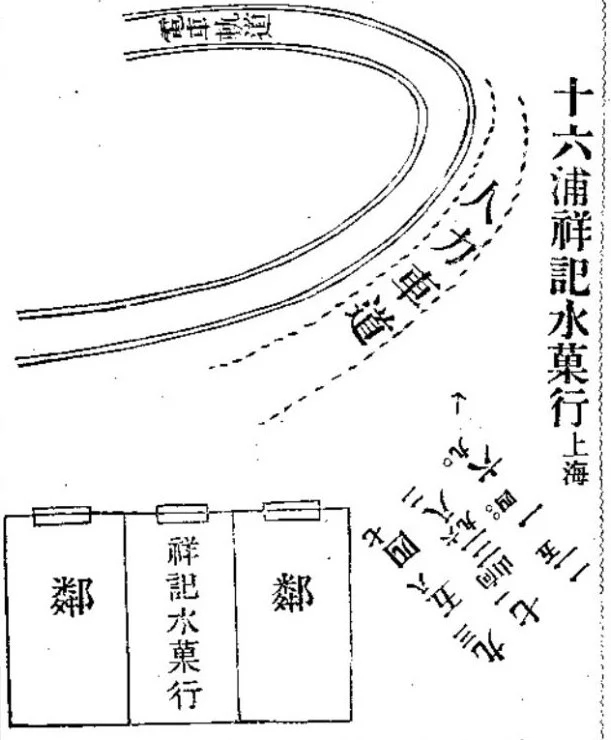
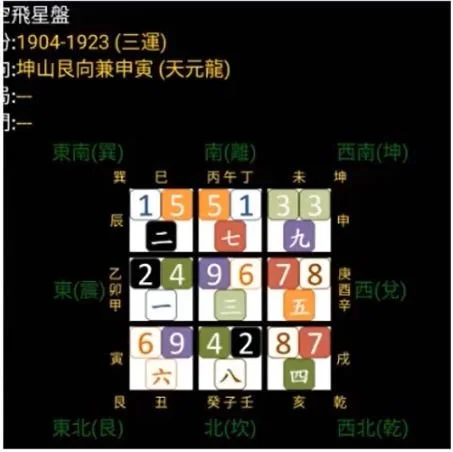
In this classic case study, the road configuration is considered together with the Flying Stars. The floor plan is accompanied by the star chart, rotated to indicate how the building faces.
The Shiliupu Xiangji Fruit Store case, by Master Yen Pen: a shop that prospers financially when the facing receives strong wealth energy:
“Ample Qi rushing in, strong wind blowing from auspicious direction [bringing in wealthy water stars #4 and #9].
Heaven extends a helping hand, making every family a rich man.”
Curious to know where the Wealth Star #9 is located in your home and how to activate it?
If you feel that your experiences can be related to the energy of your place, maybe it’s time to have your Flying Stars checked.
References:
“The Book of Burial (Zang Shu)” by Guo Pu (276-324) translated by Juwen Zhang
“The Complete Idiot's Guide to Feng Shui”, 3rd edition, by Elizabeth Moran and Joseph Yu.
East Asian History NUMBER 10 Papers on Far Eastern History
In and Outside the Square, vol. 2: Representations and Identities of High Powers in Neolithic and Bronze China